


Financing Your Aerospace & Defense Business: Match Capital to Your Stage and Plan for the Valleys of Death
There’s a lot of money out there for aerospace and defense companies. Nobody on our panel disputed that. vcfo joined Taft, the Colorado Space Business Roundtable, and the NDIA Rocky Mountain Chapter in Denver on July 28 to talk through funding strategies and sources for A&D businesses, and every panelist, from the grant administrators, to the lender, to the venture investor, started from the same place. The capital exists.
The sources of capital vary depending on a company’s stage, risk profile, and nature of the business. Between stages are gaps where good technologies run out of runway.
Here’s what I’d want a founder or CEO to take away from the hour.
Match the capital source to your stage and your risk
Financing isn’t one-size-fits-all. Every source has its own appetite for risk and its own price.
Government programs sit at the earliest, riskiest end. The federal SBIR and STTR programs and state programs like Colorado’s Advanced Industries Accelerator fund technology when it isn’t yet clear the technology will work at all, and they do it without taking equity.
Venture capital comes next: early-stage companies with big growth potential, real risk, equity in exchange. Venture debt is really a subset of venture capital. It usually follows an equity round and is sized against it.
Private equity shows up later. PE investors want revenue, customers, and earnings..
Then there’s lending, which runs from moderate-risk options (SBA-backed loans, specialty and asset-based lenders, private credit) all the way to traditional banks, which don’t take much risk at all. Banks lend to companies that are already operating, with assets and EBITDA to show for it.
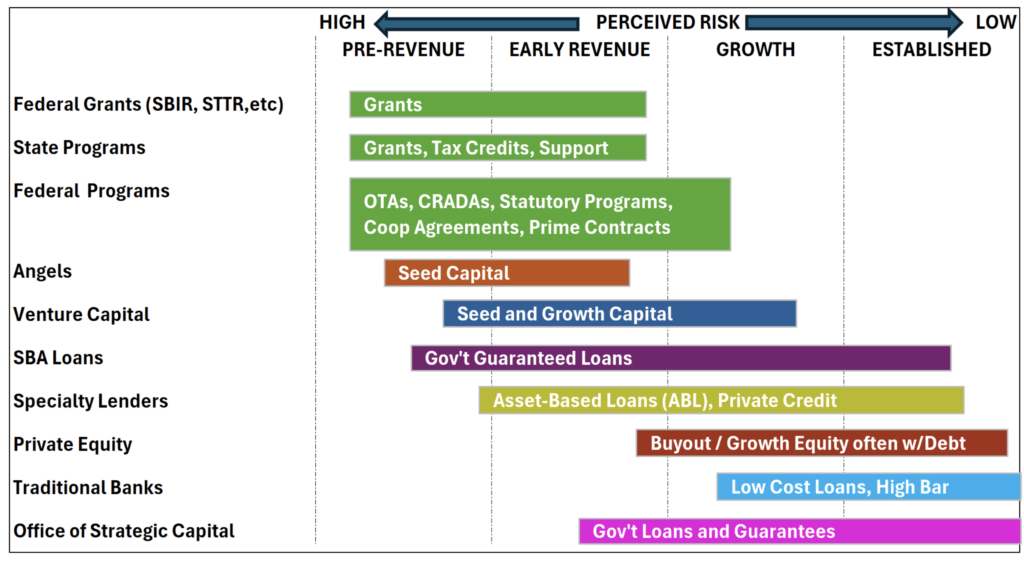
The mistake we see most is companies shopping in the wrong aisle. A pre-revenue prototype pitched to a bank. A venture pitch before anyone has touched the government programs built for exactly that stage. Knowing where you sit on the continuum, and being honest with yourself about it, saves months.
Plan for the valleys of death
A chart like the one above can leave you thinking there’s financing for every stage. There isn’t. There are natural gaps, what people in this world call valleys of death, where capital gets much harder to find.
The first sits between early government support and proven commercialization. Government programs are active through research and early development, then they taper off, and until you can show commercial traction, investors and industry partners are hard to attract. The second comes at deployment. You’ve got something that works and maybe some early customers, but you’re still too early for bank debt and usually too late for the government money.
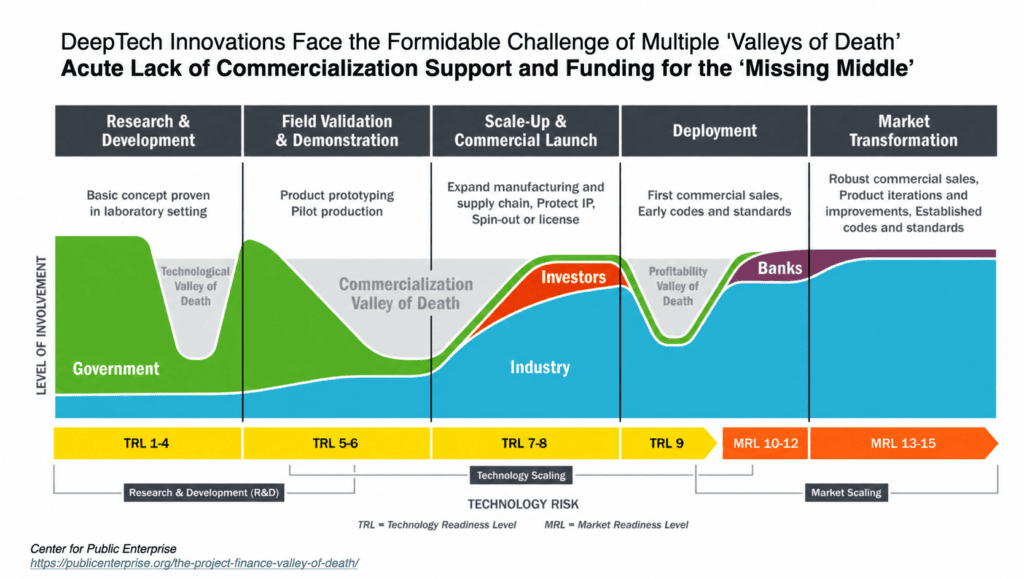
How do you cross one? There’s no formula. Asking for one is a bit like asking how to build an aircraft carrier. What there is, is a mindset: you know the hurricane is coming, so you get ready before it hits. Raise enough in the strong windows to carry you through the weak ones. Don’t overhire going into a stretch where money will be tight. And time your grant applications and raises for when the company is at a peak, with your best data and your cleanest story, rather than when you’re in the trough. Panelists said it more than once: submit when you’re most competitive, not when you’re most desperate.
Non-dilutive money first: SBIR, STTR, and state programs
The panel spent a good chunk of the hour on grants, and rightly so. There’s a great deal of federal money available. The hard part is knowing which programs exist, where to find them, and how to get in front of the right people.
The SBIR and STTR programs work in phases. Phase I funds feasibility and R&D, generally up to roughly $300,000 under the standard guidelines. Phase II funds prototype development and commercialization and runs into the low millions depending on the agency and the topic; some Department of Defense topics go higher. Phase III is commercialization itself. It carries no SBIR money, but it opens the door to sole-source government contracts. The dollars available jump sharply between phases, so applying at the right one matters. STTR is the same idea with one main difference: it requires a formal partnership with a research institution. One timing note. Congress reauthorized both programs through 2031 in April 2026 after a lapse that froze new solicitations for several months, so agency calendars are still settling.
Colorado companies have state options too. OEDIT’s Advanced Industries Accelerator offers Proof of Concept grants that run through research institutions (up to $150,000), Early-Stage Capital and Retention grants for companies commercializing technology in Colorado (up to $250,000), Export grants that reimburse international business-development costs, and an Advanced Industry Investment Tax Credit worth 25% of a Colorado investor’s investment (35% in rural or enterprise-zone locations). OEDIT’s Global Consultant Network also does no-cost market-entry consulting, market research included, for advanced-industries companies expanding overseas.
Grants do more than fund the work. A competitive government award is validation, and it strengthens every raise that comes after it. One panelist put it bluntly: if the government won’t fund it, why would a VC?
What makes a technology financeable
Two things came up from every seat on the panel, investors and lenders and grant administrators alike.
The first is dual use. A technology with both a government application and a civilian one is markedly easier to finance. The market is bigger, you’re not hostage to a single procurement cycle, and an investor can underwrite a commercial revenue path.
The second is a clear commercialization path. You need to be able to say who your customers are, how they’ll use the product, why it matters to them, and how it scales. A lot of technical founders remind me of a sixteen-year-old with a new wrench set on Christmas morning, walking around the house looking for nuts to tighten. You have to know which nut you’re going to tighten, demonstrate it, and have a plan for it.
That means doing the market research. Panelists kept coming back to market-value fit, meaning evidence that the product answers a real, sized need, and to having a market research report that proves you did the work. Surround yourself with domain expertise, show how you’ll scale, and, especially for equity investors, make sure the management team is one they’d back.
Seven mistakes that take companies out of the running
The panel spent real time on why strong companies lose grant competitions. Most of it is avoidable.
- Not reading the full solicitation. Each grant tells you exactly what’s required. People skim, skip a step, and get disqualified on process before anyone looks at the technology.
- Late or mismatched registrations. Get ahead on SAM.gov, Grants.gov, and any agency-specific registrations, and make sure your company information is identical across all of them. Discrepancies create delays, and doubts.
- Leaving character space on the table. If the application gives you 5,000 characters, don’t turn in 30 words. Use the room to explain what you’re doing and why it matters.
- No letters of support. Letters from industry experts, prospective customers, and other backers carry weight with reviewers.
- Unrealistic projections. Reviewers want a plan they can believe, not a hockey stick.
- Wrong phase, wrong amount. Match the request to where you actually are (feasibility, commercialization, or contract) and to what that phase funds.
- Submitting from a valley. Apply when the company is at its most competitive. If you’re scrambling to close a gap, reviewers can usually tell.
Get in front of the right people
Money doesn’t win awards on its own. Visibility does. Every panelist said some version of the same thing: reviewers and agencies want to know who you are.
So go where they are. Attend the conferences and events where the branch or agency you want to work with will be in the room and introduce yourself. Engage with the Defense Innovation Unit, which exists to connect commercial technology with Department of Defense needs. And use the advisers built for you. In Colorado, the Colorado SBDC TechSource program, which Audrey Miller of the Boulder SBDC represented on our panel, offers no-cost advising, SBIR/STTR proposal help, and direction on where to go next. OEDIT’s Advanced Industries team, represented by Rama Haris, manages the state’s grant and tax credit programs directly. Some organizations manage money and some give advice and referrals. Use both.
Venture capital and private equity: know what you’re walking into
Several panelists were candid about this. Venture capital isn’t usually the best fit for aerospace and defense companies, and it’s rarely the first place to look. VC has moved hard toward software, and now AI, because those businesses scale without heavy capital expenditure. A lot of A&D requires exactly the CapEx that venture firms would rather avoid.
If you do go after VC, show up ready. Exhaust the government funding and grant programs first. Bring your CapEx requirements and an honest timeline to execution. Prove the product or prototype meets a real demand and say which market. Show how it scales. Surround yourself with domain expertise and make sure your management team is one an investor would back.
Fred Chang of Qomo Capital offered a useful counterpoint to the usual “bet on the founder” venture model. In deep tech, which often means a university spinout led by a brilliant PhD who has never run or commercialized a company, his firm gets hands-on: building a team around the founder, shaping go-to-market, supporting manufacturing scale-up. If you’re a technical founder, look for investors who bring that kind of involvement and not just a check.
Private equity is a different animal. PE wants revenue, customers, and earnings before it engages. That money goes to businesses that are already scaling; the inventing has to be done.
Debt: banks, SBA, and specialty lenders
Lending is its own specialized world, and you could write a full post on SBA programs alone. The essentials from the panel:
Traditional bank financing is for companies that are already operating, with assets and EBITDA to show for it. Big banks generally need you to fit a standard box. Smaller banks are more relational and can flex for a specific niche.
SBA lending is often the answer for businesses that don’t yet qualify for a conventional bank loan. The 7(a) is the most popular program, capped at $5 million. A rule that took effect July 4, 2026 now lets eligible borrowers combine 7(a) and 504 financing for up to $10 million in total, with extra 504 flexibility for small manufacturers. For a capital-intensive A&D operator, that’s a meaningful change.
Specialty lenders, asset-based lenders, and private credit will take on more risk than a bank will. You’ll pay more for it.
You don’t have to figure this out alone
Everything above came out of a single one-hour panel, and even the panelists agreed it’s hard to become an expert on all of it at once. You don’t have to. There are people who have danced this dance with many companies at many stages, and who can help you work out where you sit on the continuum, when to raise, how much, from whom, and what your numbers and your story need to look like when you get there.
That’s the work vcfo does with aerospace and defense companies from our Denver office and across our markets: building the forecasts and financial models funders expect, getting you ready for due diligence, timing raises around the gaps, and connecting you with the right lenders, investors, and programs. If a raise is coming, whether grant, equity, or debt, let’s talk about where you are and where you want to go.
Our thanks to co-hosts Taft, the Colorado Space Business Roundtable, and NDIA Rocky Mountain Chapter, and to panelists Audrey Miller (Boulder SBDC), Fred Chang (Qomo Capital), Shawn Cheadle (Taft), Brett Haigler (Commercial Capital Connector), and Rama Haris (Colorado OEDIT).